
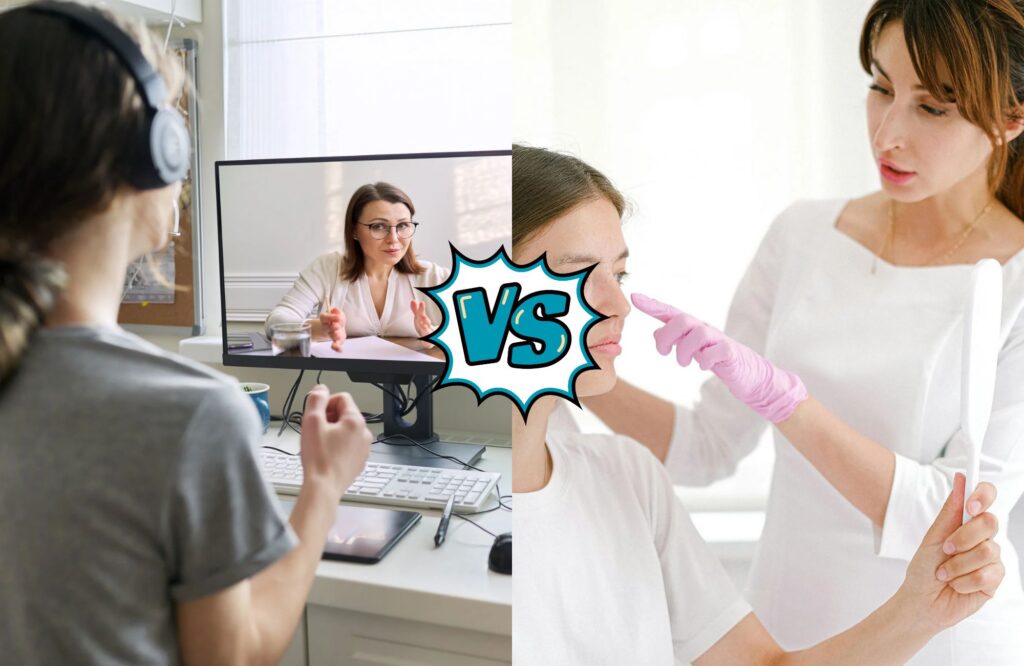
A remote medical scribe can handle much of the same clinical documentation as an in-person scribe without sitting in the exam room. Both models can document patient visits, update the EHR, record medical history, and prepare notes for doctor review. The main differences involve cost structure, physical access to the encounter, technology needs, staffing flexibility, and how the scribe communicates with the physician.
Neither model is automatically more accurate or more efficient. The result depends on training, medical terminology knowledge, EHR skills, audio quality, workflow design, physician feedback, and quality checks. For a medical practice, the better choice is the one that reduces documentation burden without adding new problems for providers, patients, compliance, or staff.
What Does a Remote Medical Scribe Do?
A remote medical scribe listens to patient visits from another location and documents relevant clinical information in the electronic health record. The scribe may capture the patient’s history, exam details stated by the provider, test results, assessment, treatment plan, and follow-up instructions. The physician remains responsible for the care and final medical record.
A virtual medical scribe usually connects to the encounter through secure audio or video technology. Some scribes work live during the visit, while others receive encounter information through an asynchronous workflow and prepare the note afterward.
A Typical Remote Scribe Workflow
A real-time workflow may look like this:
- The scribe reviews permitted patient information before the appointment.
- The scribe connects to the patient visit through an approved system.
- The physician conducts the exam and communicates findings.
- The scribe creates or updates the clinical note in the EHR.
- The scribe may prepare permitted orders or other documentation as directed.
- The physician reviews the record, corrects details when needed, and signs the note.
Remote scribes can work inside common EHR systems used for clinical documentation, but access should match the person’s actual role. A medical scribe should not make diagnoses, decide treatment, prescribe medications, or replace physician judgment.
The model can work especially well for telehealth because the patient encounter already takes place through remote technology. In an office setting, good microphones, stable connectivity, clear communication, and a defined backup process matter more because the scribe cannot rely on being physically present.
Remote and In-Person Scribes Differ Most in Workflow and Cost
Remote and in-person scribes serve the same basic purpose: reduce the documentation work that falls on doctors and other providers. The key difference is where the person works. That location changes how the scribe observes exams, communicates with the team, uses office space, handles technology, and scales with patient volume.
| Factor | Remote Medical Scribe | In-Person Medical Scribe |
| Location | Off-site | Inside the practice |
| Clinical documentation | Real-time or asynchronous | Usually real-time |
| Physical exam visibility | Limited to available audio/video | Direct room visibility |
| EHR access | Secure remote access | On-site or network access |
| Office space | Usually not needed | Needed |
| Technology dependence | Higher | Lower |
| Telehealth support | Strong fit | Less practical |
| Staffing flexibility | Easier to scale across locations | Tied more closely to location |
| Direct team communication | Digital or audio | Face-to-face |
| Cost structure | Service or remote staffing costs | Wages plus possible benefits, workspace, equipment, and hiring costs |
An in-person medical scribe has an advantage when physical context matters. The person can see room movement, nonverbal cues, procedures, and other details that may not come through an audio feed.
Remote scribes have a different advantage. A practice can add support without adding another person to each exam room or finding workspace. Remote coverage can also serve physicians across several locations.
For healthcare leaders, the decision should focus on the complete workflow rather than the location alone.
Does a Remote Medical Scribe Sacrifice Accuracy?
Remote location alone does not determine documentation accuracy. Accuracy depends more on the scribe’s training, specialty knowledge, communication, EHR skills, audio quality, physician preferences, and review process. A remote program should measure errors and corrections instead of relying on a broad claim that its notes are simply “highly accurate.”
There is no strong evidence for one universal accuracy percentage that applies to every remote scribe, specialty, or medical practice.
Useful quality measures include:
- Missing clinical details
- Incorrect patient information
- Wrong medical terminology
- Physician correction rate
- First-pass note acceptance
- Turnaround time
- Repeated errors
- Specialty-specific documentation problems
Training Is a Core Part of Scribe Quality Control
The Joint Commission’s April 2026 guidance on documentation assistants says people performing documentation assistance should receive education or training in medical terminology, HIPAA, billing and coding principles, EMR navigation, and applicable order-entry processes. Organizations should also define qualifications, scope, training, and continuing competency.
This makes specialty training important. A scribe supporting cardiology may need different knowledge from one assisting dermatology, orthopedics, or primary care.
Templates can improve consistency, but templates alone are not enough. The team also needs clear rules for abbreviations, medical history, prescriptions, test results, uncertain statements, and information that requires physician clarification.
The physician still owns the clinical decision. For Medicare documentation, current CMS signature guidance states that when a scribe, including AI technology, helps document a medical record entry, the physician or other responsible practitioner signs the entry to authenticate the documentation and the care provided or ordered.
Remote Scribe Cost Requires More Than an Hourly Comparison
Remote scribes can cost less than in-person staff, especially when the practice avoids local recruiting, dedicated workspace, equipment, and some employment overhead. Still, an hourly rate does not show the full cost. Training, management, replacement coverage, technology, security, and physician correction time can change the financial result.
A useful cost comparison should include:
| Cost Area | What to Review |
| Compensation | Wage, monthly fee, or service rate |
| Recruitment | Sourcing, screening, and hiring time |
| Training | EHR, specialty, privacy, and workflow training |
| Benefits/payroll | Applicable costs under the staffing model |
| Workspace | Desk, office, exam-room space |
| Equipment | Computer, headset, secure connection |
| Management | Team lead and performance supervision |
| Coverage | Absence and replacement process |
| Quality | QA review and correction workload |
| Technology | Remote-access and communication systems |
Productivity can also affect the calculation, but practices should use realistic assumptions.
A 2015 cardiology-clinic study found that physicians working with scribes saw 9.6% more patients per hour than physicians without scribes. A multicenter randomized emergency-department trial found that scribes increased overall physician productivity by 15.9%, with primary consultations increasing by 25.6%.
Those studies involved medical scribes generally, not one universal remote staffing model. They support the idea that scribe programs can increase capacity, but they do not justify promising every clinic 10%, 20%, or 30% more daily patient visits.
How Much Physician Time Can a Remote Scribe Save?
Remote scribes can reduce physician EHR and documentation time, but the amount varies substantially across specialties and workflows. The strongest current studies report measurable savings rather than one fixed 25–40% reduction. Practices should track their own baseline EHR time, note time, after-hours work, and correction time before judging success.
A 2024 JAMA Network Open study led by Lisa Rotenstein, MD, and colleagues examined 144 physicians who had used virtual scribes for at least three months. Total EHR time decreased by an average of 5.6 minutes per appointment after scribe use. Note time fell by 1.3 minutes per appointment, while after-hours “pajama time” fell by 1.1 minutes per appointment.
For a physician with 20 appointments, 5.6 minutes per appointment equals 112 minutes in a simple daily calculation. That is an illustration, not a promise, because the study found meaningful differences across specialties.
Dr. Rotenstein described the scaling problem with in-room support simply: “cost and space make this a difficult solution to scale.”
Another remote-scribe evaluation from the University of Wisconsin research team found a 1.14-hour reduction in total EHR time per eight scheduled patient hours compared with controls. It also found improvement in several physician wellness measures.
Patient experience does not necessarily decline when the scribe is remote. In a randomized trial of 50 new-patient visits with one orthopedic foot-and-ankle surgeon, virtual scribing reduced documentation away from the patient from 5.8 minutes to 1.2 minutes, with no significant differences in measured patient satisfaction, empathy, understanding, or perceived physician time.
HIPAA, EHR Access, and Order Entry Need Clear Controls
A remote scribe program needs more than a statement that the vendor is “HIPAA compliant.” The practice must understand who can access protected health information, what each person can do inside the EHR, how activity is tracked, what happens after a security incident, and what contractual protections apply to outside organizations.
When an outside company qualifies as a business associate because it creates, receives, maintains, or transmits PHI for a covered entity, the HHS business associate rules generally require an appropriate business associate agreement, or BAA. The agreement defines permitted uses and disclosures and requires safeguards for protected health information.
Every Scribe Should Have Traceable Access
The current HIPAA Security Rule requires access controls, audit controls, authentication, and transmission security. HHS also identifies unique user identification as a required access-control specification. Shared physician credentials make accountability harder and conflict with the need to track individual access.
The Joint Commission also lists documentation assistants using a physician’s login as a potential safety issue.
Encryption needs accurate wording. Under the Security Rule currently in effect, encryption is an addressable implementation specification rather than an unconditional requirement in every situation. HHS proposed stricter rules that would generally require encryption of ePHI at rest and in transit, but that proposal has not replaced the current rule as of September 2026.
HIPAA does not impose a blanket U.S.-only data-location rule. HHS cloud guidance states that ePHI may be stored outside the United States when applicable HIPAA requirements are met, while geographic risks must be considered in the required risk analysis and risk-management process. That guidance should not be treated as blanket approval of every offshore staffing arrangement, so practices should separately review the scribe’s access model, applicable business-associate relationships, state requirements, contracts, payer terms, and internal policies.
Scribes Can Prepare Orders Within Defined Limits
The Joint Commission states that documentation assistants may enter orders at the direction of a physician or other licensed practitioner. A person who lacks authority to submit the order should leave it pending for authorized personnel to verify and activate.
That distinction matters for lab tests, imaging, medications, and other orders. The scribe assists with documentation; the provider remains responsible for clinical decisions and required verification.
Strong Remote Scribe Programs Use Training, Metrics, and Feedback
Remote scribe success depends on the operating system around the person, not just the person’s typing speed. A strong program defines what the scribe may document, how the physician communicates corrections, which EHR functions are permitted, how quality is reviewed, and what happens when technology or staffing fails during patient visits.
Before independent work starts, training should cover:
- Medical terminology and specialty language
- EHR navigation
- Note templates
- Patient information and privacy rules
- Practice-specific workflows
- Order-entry boundaries
- Escalation procedures
- Audio and technology problems
- Physician preferences
- Common documentation mistakes
Testing before solo work can reveal gaps in note structure, terminology, EHR skills, and communication. After launch, ongoing feedback matters because physicians differ in how they structure notes and describe exams.
Useful performance indicators include first-pass acceptance, correction rate, documentation turnaround, attendance, physician satisfaction, QA results, and the amount of physician EHR time saved.
A managed remote model can also give a practice structured supervision rather than leaving each physician responsible for hiring and monitoring a person alone. Stella’s healthcare staffing teams use workflow mapping, documented SOPs, training, KPI reporting, and ongoing QA reviews, which are the same operational controls a practice should look for when evaluating remote clinical support.
Clear documentation can also give coding and billing teams better records to work from. It should not be treated as a guarantee of fewer claim denials, however. Coding accuracy still depends on the documented clinical facts, applicable coding rules, payer requirements, and provider authentication.
AI Will Support Scribe Work, but Physician Review Still Matters
AI is changing clinical documentation, but human remote scribes and AI scribes are not the same service. AI can draft notes from patient conversations, while human scribes can interpret workflow context, follow physician preferences, communicate questions, and complete permitted EHR tasks. Future programs are likely to combine automation with human review.
The change is already measurable. A 2026 multisite study of 8,581 ambulatory clinicians, including 1,809 AI-scribe adopters, found that adoption was associated with 13.4 fewer minutes of total EHR time and 16.0 fewer documentation minutes per eight scheduled patient hours, plus 0.49 additional weekly visits. Outside-work EHR time did not change significantly, and the researchers characterized the overall gains as modest.
That result does not mean AI replaces a trained medical scribe. It shows where technology can take over part of the documentation workload.
Human scribes may increasingly spend less time typing every sentence and more time checking drafts, correcting terminology, organizing records, confirming missing details, and managing EHR workflows. The specific role should still stay within organizational rules and the person’s qualifications.
CMS already addresses this shared responsibility. Its 2025 Medicare guidance says that when a scribe or AI technology documents an entry, the responsible practitioner signs it to authenticate the record.
The practical model is not “human versus technology.” It is technology plus defined human oversight, clear accountability, and physician review.
Which Scribe Model Fits Your Medical Practice?
The right scribe model depends on the type of patient visits, specialty, documentation burden, technology, staffing model, and amount of physical observation required. Remote support works best when encounter information can be captured reliably through the approved workflow. In-person scribes remain useful when room context and physical presence add meaningful value.
A remote medical scribe may be a stronger fit when your practice has:
- Several providers or locations
- Telehealth visits
- Limited office or exam-room space
- High after-hours charting time
- Need for scalable coverage
- Stable audio and EHR technology
- Clear documentation workflows
- A process for remote supervision and QA
An in-person scribe may be more practical when the workflow involves complex room movement, frequent procedures, limited connectivity, heavy reliance on nonverbal information, or other tasks that require physical presence.
Before choosing, measure the current state. Look at physician EHR hours, after-hours documentation, charts completed on time, note corrections, staffing cost, patient volume, and physician satisfaction. Set targets for the same measures after launch.
This makes the decision easier to defend. The goal is not simply to hire a cheaper scribe. The goal is to create a documentation workflow that gives doctors more time for patients while keeping medical records accurate, secure, and complete.
Conclusion
A remote medical scribe can provide many of the same documentation benefits as an in-person scribe with greater location and staffing flexibility. Evidence shows that virtual and remote scribes can reduce EHR time, but results vary across physicians and specialties. Accuracy depends on training, communication, access controls, QA, and physician review rather than location alone. Practices should compare total cost, clinical workflow, security, and measurable physician time before selecting a model.
At Stella Hire, we build and manage remote teams around defined healthcare workflows, training requirements, and performance goals. We help practices structure remote scribe support around EHR access, documentation processes, staffing coverage, supervision, and ongoing quality checks. Contact us to discuss the remote medical scribe setup that fits your practice.